


Cotton Woven Cotton Filter Bag
30 May 2024
PPS Filter Bag
30 May 2024
Polyimide (P84) Filter Bag
Polyimide (P84) Filter Bag is ideal for use in boilers and blast furnaces where temperatures are high and acidic or basic concentrations are high. The most common Polyimide fiber is “P84®”
Unit price per m²: 11.00 EUR/m². Contact us for an up-to-date quote.
A polyimide (P84) filter bag is a felt filter element used for flue gases that operate at high temperature and carry fine dust. P84 is the most common trade name of polyimide fiber. The fiber withstands both temperature and acidic and basic components; thanks to the structure of the fiber cross-section, it retains fine dust on the surface of the felt. The sections below describe the bag’s construction, technical values, its difference from other high-temperature fibers, and the manufacturing and maintenance conditions.
Construction of the P84 Filter Bag
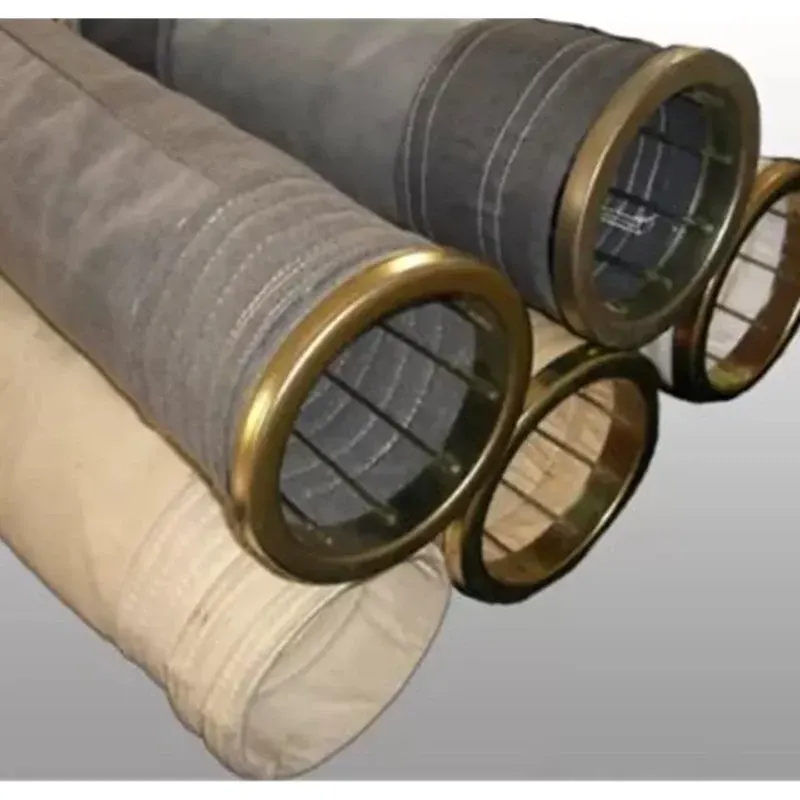
The bag is made of 100% polyimide fiber. Short fibers are needled onto both faces of a supporting scrim that is also woven from polyimide yarn. The scrim gives the felt tensile strength and dimensional stability.
The cross-section of the polyimide fiber is not round but multi-lobed. This structure creates a larger fiber surface at the same weight. Fine dust is retained in the upper layer without penetrating deep into the felt. As a result, the cake layer detaches easily with the cleaning pulse and the felt clogs less over time. The fiber does not melt with heat and does not burn on its own; it keeps its shape at high temperature.
How Does a P84 Filter Bag Work?
Hot, dusty gas passes from the outside surface of the bag to the inside. Particles are retained on the surface, and clean gas passes through the inside of the bag into the clean air chamber. The wire cage inside the bag prevents collapse under suction.
When the differential pressure rises, the valve of the jet pulse bag filter unit gives a short pulse of compressed air and the cake falls into the dust hopper. Because the dust stays on the surface of P84, the differential pressure quickly returns to its previous level after the pulse. This reduces the number of cleaning cycles, compressed air consumption and fatigue of the felt.
Technical Specifications of the P84 Filter Bag
The table summarizes the values of standard polyimide felt. Exact values, including the continuous and peak temperature limits, are given in the datasheet of the ordered fabric at the quotation stage.
| Property | Value |
|---|---|
| Composition | 100% polyimide (P84) |
| Scrim | Polyimide (P84) |
| Weight | 525 g/m² ± 5% |
| Air permeability | 9,000 – 11,000 l/dm²/h (Dp: 200 Pa) |
| Thickness | 2.0 mm |
| Tensile strength | Machine direction 130 kgf/5 cm, cross direction 170 kgf/5 cm |
| Surface treatment | Calendering and singeing; water- and oil-repellent finish if required |
| Operating temperature | High-temperature class, dry gas; exact value in the fabric datasheet |
| Acid resistance | Good |
| Alkali resistance | Good |
| Hydrolysis resistance | Good |
| Solvent resistance | Excellent |
| Oxidation resistance | Excellent |
What Sets P84 Apart from Other High-Temperature Fibers
On high-temperature lines, several fibers can do the same job. The selection depends not only on the gas temperature but also on its moisture, acid and oxygen content:
- A Nomex filter bag is an economical option in dry gas at relatively lower temperatures; in humid and acidic gas, P84 is more durable.
- PPS works well in humid and acidic gas but weakens in gas with a high oxygen content; P84 is more resistant to oxidation.
- Glass fiber is used at higher temperatures, but it is more sensitive to flexing and abrasion.
- PTFE stands out on lines with a very heavy chemical load, but its cost is higher.
The real distinction of P84 is its fine-dust capture behavior. On a line with a strict emission limit, fine dust and high temperature, P84 is often the first fiber evaluated.
In some plants, hybrid solutions are also used to balance cost. For example, a felt can be produced with P84 fibers in the surface layer and a more economical high-temperature fiber in the lower layer. Such felts keep the fine-dust capture behavior of P84 on the surface while lowering the total cost. Whether a hybrid felt is suitable is evaluated at the quotation stage according to the gas composition and temperature profile.
Engineering and Manufacturing
FLTS manufactures P84 bags to the dimensions of an existing unit or for a newly engineered dust collection system. For a bag operating on a hot line, the following details are planned together:
- Felt selection: weight and surface treatment are determined according to the dust type and gas composition.
- Sewing: the sewing thread is selected from a fiber that withstands the gas temperature and chemical load.
- Top: made as snap band, drawstring or flanged, according to the tube sheet.
- Size: the bag diameter is cut with a suitable allowance for the cage, and the length is determined according to the distance to the dust hopper.
- Inspection: the diameter, length and top dimensions are compared with the sample before shipment.
Installation and Maintenance
During installation, the bag top is seated fully on the tube sheet and the cage is lowered into the bag without force. On a hot line, rust and distortion develop faster in the cages; for this reason, the filter cages are also checked at bag replacement.
In operation, the gas temperature and differential pressure are monitored together. Polyimide fiber becomes more vulnerable to hydrolysis when moisture and temperature rise together; for this reason, the unit is prevented from cooling below its dew point. At start-up the housing is preheated, and at shutdown the dust hopper is emptied while the gas is still hot. Temperature spikes are recorded; it is the highest instantaneous value, not the average, that determines bag life. All bags are replaced at the same time.
If the gas temperature operates continuously close to the polyimide limit, adding a gas cooling unit at the start of the line can extend bag life.
Factors Determining the Price of a P84 Filter Bag
The price of a P84 bag is higher than polyester and Nomex and generally lower than PTFE. The main items that determine the price are the felt weight and surface treatment, bag size and quantity, top and bottom type, sewing thread, and whether the cages will be renewed. The comparison is made not on the price of the bag but on the actual service life of the bag and the downtime cost incurred during replacement. On lines with fine dust, the effect of a low differential pressure on fan energy is also taken into account.
What Is a P84 Filter Bag and Where Is It Used?
A P84 filter bag is a felt bag made from polyimide fiber. P84 is the most common trade name of this fiber. It is used for boiler and kiln gases that run at high temperature and also carry acidic or basic components.
The cross-section of polyimide fiber is not round but multi-lobed. This structure generally helps fine dust stay on the surface of the felt; the dust falls more easily with a jet pulse without being embedded inside. For this reason P84 comes to the fore on hot lines with fine dust and tight emission limits.
Its place among the options is as follows: Nomex in dry and relatively lower temperatures; a PPS filter bag may be sufficient in humid and acidic gas with limited oxygen. If the temperature rises further, glass fiber; if the chemical load is very heavy, the PTFE filter bag is compared.
P84 Filter Bag Applications
| Industry | Role of the bag | Note |
|---|---|---|
| Cement | Capturing fine dust in kiln and clinker cooler gas | Instantaneous temperature spikes should be recorded |
| Lime and gypsum kilns | Separating dust in calcination gas | If basic dust and moisture are present together, state this in the quotation |
| Coal and biomass boilers | Filtering fly ash in hot flue gas | Life may shorten when humidity and temperature rise together; gas measurement is needed |
| Waste incineration | Removing dust from flue gas with acidic components | Gas composition is variable; a comparison with PTFE is made |
| Metal melting and blast furnace | Capturing fine metal oxide dust in melting gas | If sparks are carried, a pre-separator is used |
| Asphalt plants | Filtration of hot dust at the dryer outlet | Burner setting and unburned fuel affect the bag |
What Is Needed to Choose the Right Bag
The exact values in the fabric datasheet are given at the quotation stage. To choose the right polyimide bag, the following information is requested:
- Continuous operating temperature and short-term maximum temperature of the gas.
- Moisture content of the gas and acid-forming components.
- Dust type and particle size; state it if the fine dust ratio is high.
- The chimney emission limit you must comply with.
- Unit model, number of bags, size and top type.
- Material of the existing bag and the reason for replacement.
If there is no measurement, taking a temperature log for a short period is a sufficient start. Values at start-up and shutdown in particular show better than the average whether a polyimide bag is suitable for that line.
Frequently Asked Questions
Are P84 and polyimide filter bags the same product?
Yes. P84 is the most common trade name of polyimide fiber.
What temperature does a P84 filter bag withstand?
P84 is a fiber in the high-temperature class and can operate in dry gas at temperatures above those of Nomex. The continuous and peak temperature values are given in the datasheet of the selected fabric at the quotation stage.
Why is P84 preferred for fine dust?
The multi-lobed fiber cross-section retains fine dust on the surface of the felt. Because the dust does not become embedded inside, cleaning is easier and the differential pressure stays low.
Can a P84 bag be used in humid gas?
Its hydrolysis resistance is good, but when moisture and temperature rise very high together, life can shorten. In that case, a comparison with PPS and PTFE is made based on gas measurement.
Can a P84 bag be made to custom dimensions?
Yes. The diameter, length, top type and bottom construction are produced according to the tube sheet and cage dimensions of the unit.
When should a P84 bag be replaced?
Replacement is planned if the differential pressure does not drop after cleaning, if dust is visible at the stack outlet, or if the bag shows stiffening or discoloration.
General information on dust collection systems
| CONTENTS | 100% POLYIMIDE (P84) |
| INTERNAL TISSUE | POLYIMIDE (P84) |
| WEIGHT | 525 g/m² ± %5 |
| WEIGHTAIR PERMEABILITY | 9.000 – 11.000 lt/dm²/saat (Dp:200 Pa) |
| THICKNESS | 2.0 mm |
| BREAKING STRENGTH | Longitudinal: 130 kgf/5 cm – Transverse: 170 kgf/5 cm |
| SURFACE TREATMENT | KALENDER AND GAZE PROCESS |
| OPERATING TEMPERATURE | CONTINUOUS 260C DRY TEMPERATURE |
| ACID RESISTANCE | Good |
| ALKALINE RESISTANCE | Good |
| HYDROLYSIS RESISTANCE | Good |
| SOLVENT RESISTANCE | PERFECT |
| OXID RESISTANCE | PERFECT |
- Category
- Filter Bags
- Made in
- İkitelli OSB, Istanbul, Türkiye
- Updated